Google added a new Agentic Browsing category to Lighthouse and PageSpeed Insights in 2026. What it means for B2B and export websites, and how to prepare for Agentic Engine Optimization.
Agentic Browsing in PageSpeed Insights: why this update already changes Agentic Engine Optimization
Google added a new category called Agentic Browsing to Lighthouse and PageSpeed Insights in 2026, alongside Performance, Accessibility, Best Practices and SEO. This evolution shows that evaluating a website is no longer only about the human experience, but also about its ability to be understood and used by AI agents.
For B2B companies, exporters and matchmaking platforms, this change matters. AI agents no longer simply read a page: they compare offers, fill out forms, verify information and can become intermediaries in the buying journey. In this context, Agentic Engine Optimization — optimizing a website for AI engines and agents — becomes a natural extension of technical SEO and accessibility.
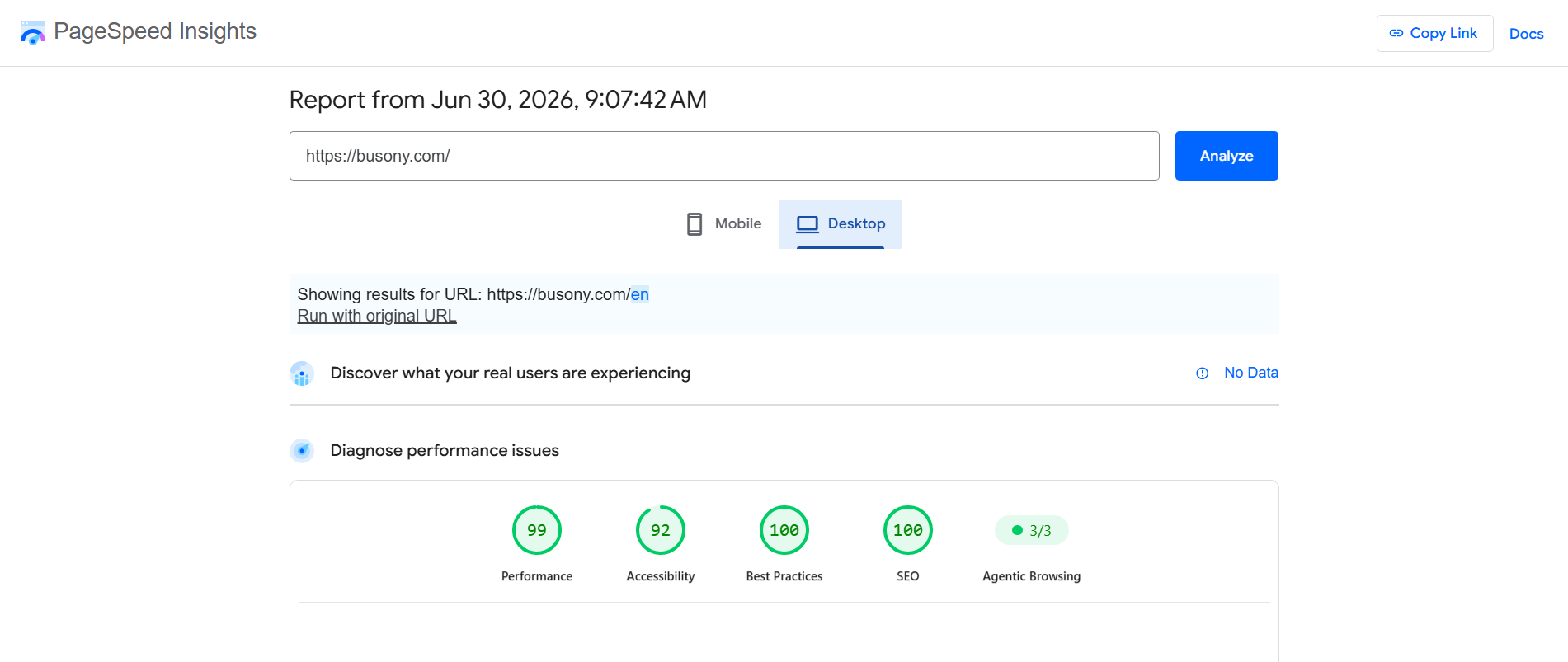 Busony.com on PageSpeed Insights (June 2026) — Performance 99 · Accessibility 92 · Best Practices 100 · SEO 100 · Agentic Browsing: 3/3.
Why Google added Agentic Browsing
For years, web optimization has focused on two main goals: making sites pleasant for humans and easy to crawl for search engine bots. The new Agentic Browsing category adds a third layer: a site's ability to be usable by AI-driven autonomous agents.
This evolution reflects a broader transformation of the web. More and more AI tools navigate interfaces, interpret page elements, trigger actions and attempt to execute tasks without constant human intervention. A website can therefore be well-ranked and relatively fast, yet remain difficult for an agent to use if its structure is ambiguous, unstable or poorly exposed.
For a company like Busony, operating in export and B2B services, this logic is particularly relevant. Tomorrow, an agent could compare multiple suppliers, read specifications, extract logistics conditions and send quote requests without a human buyer intervening at every step. If a site is not understandable by that agent, it risks being filtered out very early in the selection process.
What Agentic Browsing actually measures
The Agentic Browsing category is not a mere cosmetic change in PageSpeed Insights. It relies on a series of technical audits designed to measure whether AI agents can identify, understand and use the key elements of a web page.
The observed audits cluster around three main dimensions: agent-oriented accessibility, interface stability, and the exposure of information or actions intended for agents.
1. Agent-oriented accessibility
The first block focuses on the accessibility tree. Concretely, Lighthouse checks whether interactive elements have accessible names, whether buttons and fields are clearly identifiable, and whether the page structure allows a machine to understand the role of displayed components.
This point is decisive, because AI agents often rely on signals similar to those used by assistive technologies. If a button has no clear label, if a form field is not linked to its label, or if the semantic hierarchy is confusing, the agent may misinterpret the interface or fail to complete a task.
In other words, accessibility is no longer just a UX or compliance requirement. It also becomes a condition of operational readability for AI systems.
2. Interface stability
The second block looks at visual stability, particularly through CLS — Cumulative Layout Shift. A page whose elements shift during loading can disorient an agent trying to identify a button, field or content area at a specific location.
For a human, this shift is annoying. For an agent, it can be blocking. A "Request a quote" button that changes position during task execution can make automation fragile or unusable.
This idea is central to Agentic Engine Optimization: a site optimized for agents must be predictable. Interactive elements must stay where the agent expects to find them, and the structure must not reorganize itself unpredictably.
3. Agent-specific signals
The third block concerns more recent mechanisms like llms.txt and WebMCP. According to sources that have documented the new audits, Lighthouse can verify the presence and validity of an llms.txt file, provided it follows certain formatting rules such as using Markdown with at least one H1 header.
It is important to nuance this point. The absence of llms.txt does not automatically cause an audit failure in all cases, and this file does not currently constitute proof of better ranking in AI engines or assistants. However, it can serve as a documentation layer to explain how an agent should read, interpret or use certain parts of the site.
Lighthouse can also run audits related to WebMCP, particularly on annotatable forms, exposed tools and the validity of their schemas. These controls appear to depend on the technical context and the activation of an origin trial in Chrome, making them a more advanced topic than a generalized one for now.
Agentic Browsing is not a classic SEO score
One of the most important points to clarify: Agentic Browsing is not, at this stage, a confirmed new ranking factor for Google Search. Available analyses present it primarily as a technical audit layer designed to evaluate a site's readiness for AI agents.
In other words, passing these audits does not guarantee an improvement in SEO positions. However, failing on these points can limit an agent's ability to consume content, interact with the site and execute useful actions. For businesses, the real question is therefore not only "does this rank?", but "can an agent actually use my site?".
This is where the concept of Agentic Engine Optimization makes full sense. The goal is not to replace SEO, but to add a new optimization layer centered on interpretability, actionability and machine reliability of the web experience.
What this changes for Agentic Engine Optimization
Agentic Engine Optimization can be defined as the set of practices that make a site usable by AI agents in contexts of search, comparison, navigation and execution. Where traditional SEO seeks to make pages findable and understandable by a search engine, AEO goes further: it seeks to make interfaces usable by an agent.
In this logic, three pillars clearly emerge:
- Structural readability: clean HTML, hierarchical headings, well-segmented content, explicit labels, understandable tables and semantically correct interactive components.
- Execution reliability: stable interface, simple journeys, low ambiguity in calls to action, robust forms and predictable behavior of dynamic elements.
- Capability exposure: readable documentation for agents, files like
llms.txtwhere useful, and eventually actionable interfaces via standards like WebMCP or comparable protocols.
For a platform like Busony, this opens a very strong editorial angle. The challenge is no longer just to have "SEO-friendly" pages, but "agent-ready" pages capable of being interpreted by assistants that search for a supplier, verify an offer or trigger a contact request.
Why this is strategic for B2B export
The export sector relies on a great deal of structured information: product sheets, incoterms, minimum quantities, certifications, lead times, destinations, transport methods, quote conditions and contact forms. These are exactly the elements that AI agents will seek to collect, compare and exploit at scale.
In a B2B environment, competition is no longer just about search rankings or brand image. It will also play out on a site's ability to be queried by third-party systems, then integrated into semi-autonomous sourcing, pre-qualification and matchmaking workflows.
A poorly structured export site can lose opportunities without even realizing it. If an agent cannot clearly understand product categories, order conditions or the right form to use, it may abandon or choose a competitor that is simpler to exploit.
Conversely, an agent-ready site can become more visible in AI-driven discovery flows. It becomes easier to summarize, compare, cite and activate in a context where the agent acts as a purchasing assistant or selection filter.
First concrete actions to implement
The best way to approach this topic is not to look for an isolated "AI trick." Agentic Browsing should be treated as a logical extension of technical web excellence.
Strengthen semantic accessibility
The first priority is to audit interactive components. Every button, link, field and control must have a clear name, an explicit role and a consistent relationship with the rest of the page.
Contact forms, quote request forms and sourcing forms are particularly critical. If fields are not well labeled, if errors are not correctly communicated or if CTAs are vague, agents will encounter the same difficulties as screen-reader-assisted users.
Stabilize high-intent pages
Product pages, category pages, quote request landing pages and contact pages must be visually stable. Reserving space for images, limiting late insertions and avoiding abrupt layout changes improves both the human experience and agent reliability.
On a B2B export site, high-value journeys are often simple: consult an offer, verify a capability, submit a request. These are precisely the journeys that must be made robust and predictable.
Document what an agent can do
Publishing an llms.txt can make sense as an experimentation and documentation approach, as long as it is not presented as a silver bullet. This file can be used to explain which areas of the site are prioritized, which pages are most reliable, or what usage constraints agents must respect.
This approach is particularly useful if the site contains highly structured content, directories, catalogs or specific business rules.
Prepare the next step: agent-driven actions
In the medium term, the most advanced sites will not be content with just being readable. They will also expose actions. This can take the form of more standardized forms, documented tools, or integration layers allowing an agent to initiate a quote request, check availability or launch a business workflow.
This is where standards like WebMCP become interesting, even if they remain emerging. For innovative companies, the challenge is not only to let agents read, but to allow them to act within a controlled framework.
A new discipline to watch closely
The appearance of Agentic Browsing in PageSpeed Insights does not mean that the entire web is immediately shifting to a new era. However, it acts as an extremely strong early signal: sites will be increasingly evaluated not only for humans and crawlers, but also for agents capable of executing tasks.
For B2B brands, service platforms and export players, this change deserves to be anticipated now. The fundamentals remain the same — accessibility, structure, stability, clarity — but their value increases because they also become conditions of usability by AI.
Agentic Engine Optimization is therefore not a trend separate from SEO. It is the logical evolution of a web where being findable is no longer enough: you also need to be understandable, manipulable and exploitable by the agents that will tomorrow participate in the discovery and selection of suppliers.
Sources
[^4]: SEO vs AEO vs GEO: Which Should You Focus On? — GenRank [^10]: Ultimate 2026 Guide to LLM Optimization — Mean.CEO [^12]: AX (Agent Experience): Optimizing Your Brand for AI Agents — Goodie [^13]: How Can Agentic AI Performance Optimization Drive Speed and Efficiency — Monetizely [^14]: 7 practical tips for agentic AI cost optimization — TechTarget [^psi]: PageSpeed Insights — test your site — Google