AI SDRs automate prospecting: account sourcing, contact enrichment, personalized outreach and reply handling. A practical guide to how the pipeline works, how to evaluate or build one, and why export prospecting multiplies every requirement.
Every B2B sales team has the same cost problem: a human SDR spends most of their day on research, list-building and writing the first touch of an outreach sequence — not on the parts of the job that actually require judgment. AI SDRs exist to take over that first part: finding the right accounts, enriching contact data, writing and sending personalized outreach at scale, and handing over only the conversations that are actually worth a human's time.
This guide explains what an AI SDR actually is, how the pipeline works end to end, how to evaluate a tool or build your own, and where the category gets genuinely difficult — international and export prospecting, where language, compliance and data quality requirements multiply by every target market.
Targeting international markets? Exportik is the version of this system built specifically for export prospecting: identifying and qualifying real distributors and buyers, market by market. Discover Exportik →
The context that makes this urgent: B2B buyers already use AI to research before a rep ever reaches out. Google's AI Overviews now appear on 86.7% of business-intent searches, up from 56.9% a year earlier, and AI-referred traffic converts 42% better than traditional traffic (Peec AI data). An AI SDR prospecting into a market where the company itself is invisible in those AI answers is operating at half effectiveness.
What is an AI SDR?
An AI SDR (AI Sales Development Representative) is a software agent that performs the prospecting stage of B2B sales: identifying target accounts, finding and verifying contacts, writing personalized outreach, sending it across one or more channels, triaging replies, and handing off qualified conversations to a human closer or booking a meeting directly.
The term covers a spectrum, and the differences matter when evaluating a solution:
- Sequencer with AI copywriting: a conventional cadence tool (email/LinkedIn steps) where AI only helps draft message variants. The human still builds the list, sets the logic and manages replies.
- AI-augmented prospecting platform: the platform scores and prioritizes accounts, suggests contacts, and personalizes messages from signals, but a human still approves sends and owns reply handling.
- Autonomous AI SDR agent: the agent owns the loop — it builds its own target list from an ideal customer profile (ICP), enriches and verifies contacts, writes and sends outreach, reads and classifies replies, handles common objections, and books meetings or pushes qualified leads into the CRM with minimal human intervention.
Most of what is marketed as "AI SDR" today sits in the second category. True autonomous agents are younger, improving quickly, and still benefit from human oversight on message approval and list quality — particularly outside English-speaking, single-market contexts.
How the pipeline actually works
A working AI SDR system is a chain of fairly distinct steps, not one black box:
1. ICP definition and account sourcing — the target profile (industry, size, geography, signals such as hiring or funding) is translated into a query against a company database or registry. 2. Contact discovery and enrichment — identifying the right buyer persona inside each account, then resolving a verified email, phone number or LinkedIn profile. 3. Data verification — removing invalid, bounced or duplicate contacts before any outreach is sent, which is what protects sender reputation and deliverability. 4. Personalization — generating a first-touch message grounded in real signals about the account (not generic mail-merge), and often a two- or three-step follow-up sequence. 5. Multichannel sending — email, LinkedIn, sometimes an outbound call or SMS, usually spaced to respect deliverability limits and reply-rate patterns. 6. Reply classification — separating interested replies, objections, out-of-office, unsubscribe requests and wrong-contact signals, and responding appropriately to each. 7. Qualification and handoff — a structured handoff to a human rep or direct calendar booking, usually with the full conversation history and account context attached. 8. CRM synchronization — writing contacts, activities and deal stages back into the CRM so the agent's work is visible and attributable.
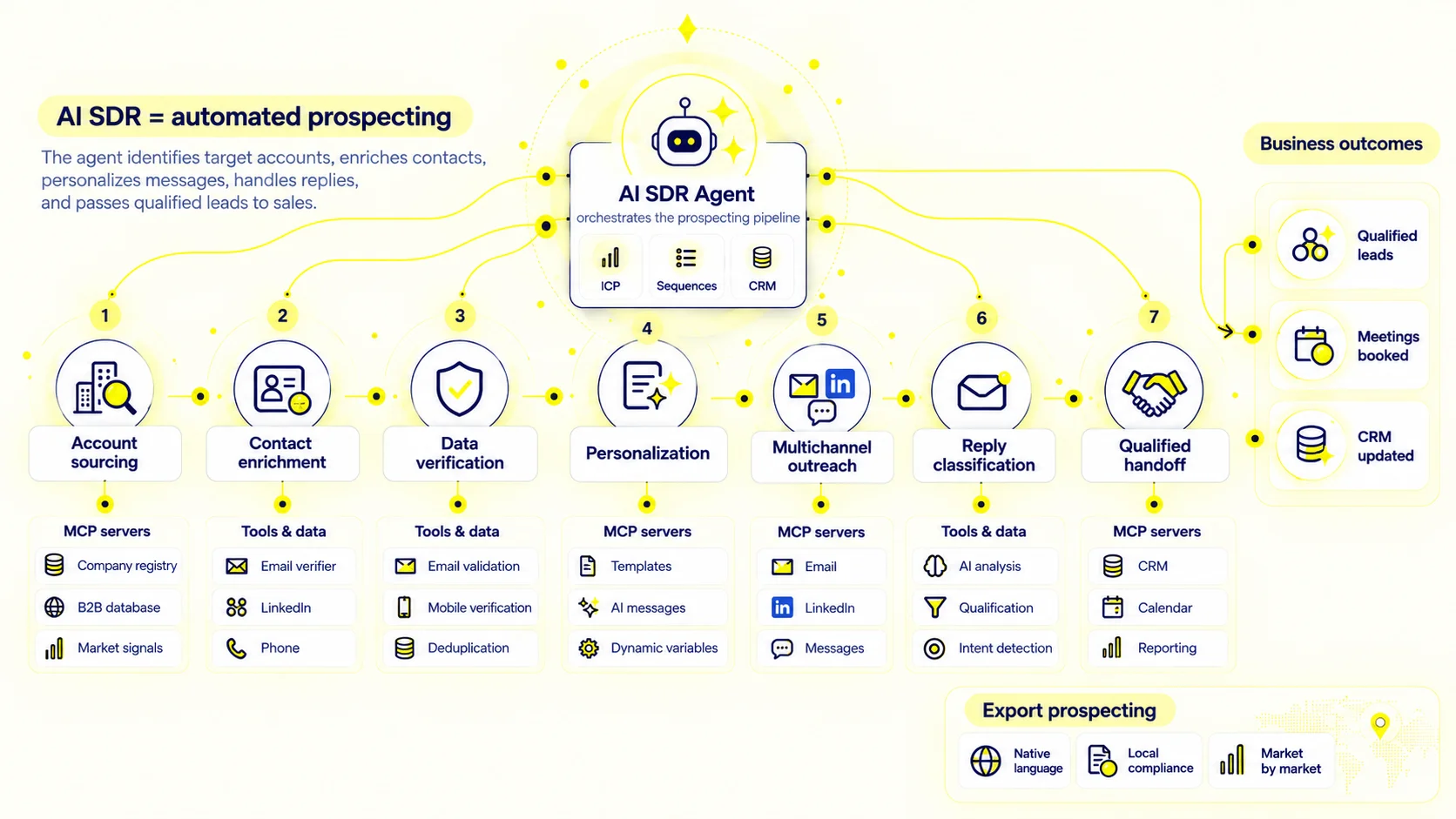
The quality of an AI SDR is determined far more by steps 1–3 and 6–8 than by how fluent the generated message sounds. A beautifully written email sent to a stale or wrong contact, or a qualified reply that never reaches a human, is a failed pipeline regardless of copywriting quality.
Build vs. buy
| Factor | Off-the-shelf AI SDR platform | Custom-built agent |
|---|---|---|
| Time to first campaign | Days | Weeks to months |
| Data source flexibility | Limited to the vendor's integrations | Any source you can connect |
| Compliance control | Depends on vendor configuration | Full control, your responsibility |
| Multilingual and multi-market depth | Varies widely; often English-first | Can be built market by market |
| Ongoing cost | Subscription, scales with seats/sends | Engineering and maintenance cost |
| CRM and internal-tool fit | Pre-built connectors | Exact fit to your stack |
A custom-built agent is usually assembled the same way the rest of this site has described for agentic systems: MCP gives the agent controlled access to the tools and data it needs (company registries, enrichment APIs, the CRM, email sending), and, where the prospecting function is delegated to a specialist agent rather than called as a tool, A2A lets that specialist operate independently and report back task status and artifacts. For a deeper look at that distinction, see A2A vs MCP: The Complete Guide to Agent-to-Agent and Agent-to-Tool Protocols.
Off-the-shelf platforms move faster initially. Custom agents win when the target markets, compliance requirements or data sources are not well served by a generic vendor — which is exactly the situation most export-focused prospecting falls into.
What to evaluate before choosing a solution
- Data quality and verification, not just data volume. A large but unverified contact database produces bounces and damages sender reputation.
- Deliverability management: domain warm-up, sending limits, SPF/DKIM/DMARC configuration, and reply-rate monitoring.
- Personalization depth: does the system use real account signals, or does it fill a template with a first name and company name?
- Reply handling accuracy: how well objections, unsubscribes and genuine interest are distinguished, and what happens when classification is wrong.
- Human-in-the-loop controls: can a human review and approve messages before they send, especially during the first weeks in a new market?
- Compliance posture: GDPR basis for processing, opt-out handling, and country-specific B2B outreach rules, which differ more than most teams expect.
- Multilingual and cultural adaptation: machine-translated outreach reads as machine-translated outreach. Native-quality copy in the target language, adapted to local business norms, measurably changes reply rates.
- CRM and reporting integration: whether pipeline, not just activity, is visible to the sales team using the system day to day.
Security and compliance are not optional
An AI SDR touches personal data (names, emails, phone numbers, job titles) and performs an outbound communication action — two things that carry real regulatory and reputational risk if handled carelessly.
Minimum practice:
- A documented legal basis for processing and contacting each prospect, consistent with GDPR for European targets and the applicable regime for any other target market.
- A working, immediate opt-out mechanism, honored across every channel the agent uses.
- Rate limits and sending caps that protect domain reputation rather than maximizing short-term volume.
- Human approval for new sequences, new markets or new personas before autonomous sending begins.
- An audit trail: what was sent, to whom, when, and what the agent decided and why.
- No sensitive personal data beyond what is strictly needed for a legitimate B2B outreach purpose.
These same principles apply whether the agent is built on MCP tools, a vendor platform, or a hybrid: the protocol does not create the safety, the implementation does.
The hard version of the problem: international and export prospecting
Domestic, single-language AI SDR is already a meaningfully hard engineering and data problem. Export prospecting multiplies every part of it:
- Company and contact data quality varies by country. A registry that is excellent for French SMEs may be thin or structured differently for German Mittelstand companies or Polish distributors.
- Outreach language must be native-quality, market by market, not one message translated five times. A generic translated email reads as exactly that to a buyer, and reply rates reflect it.
- Compliance differs by jurisdiction. B2B outreach rules, data protection requirements and accepted sending practices are not uniform across the EU, let alone outside it.
- Time zones, business calendars and response-time norms differ, which affects both sequence timing and how quickly a qualified lead needs a human follow-up.
- Qualification criteria shift by market. A distributor profile that converts in Benelux may not be the right profile in Germany or the Nordics.
This is the specific problem Exportik is built to solve: identifying and qualifying real distributors and buyers market by market, with country-appropriate data sourcing and outreach rather than a single generic sequence pointed at translated contact lists.
Exportik in practice: verified distributor sourcing, automated qualification and native-language prospecting, market by market. See how it works → For a market-by-market comparison of AI tools in the export-agent space, see AI Agents for Export in 2026: a Comparison of Existing Solutions.
FAQ
Is an AI SDR the same as a chatbot?
No. A chatbot responds to inbound visitors who are already on a website or in a conversation. An AI SDR is outbound: it identifies targets, initiates contact and drives a conversation toward a qualified outcome.
Can an AI SDR fully replace a human SDR?
For the research, list-building and first-touch stages, largely yes, with appropriate oversight. For nuanced objection handling, relationship-sensitive accounts and final qualification judgment, human involvement still improves outcomes, particularly early in a new market or segment.
How is an AI SDR different from a basic email sequencer?
A sequencer automates sending a predefined set of steps. An AI SDR typically also builds the target list, enriches and verifies contacts, personalizes messages from real signals, and classifies and routes replies — a materially larger share of the job.
Does an AI SDR need access to the CRM?
Yes, for the system to be useful rather than a parallel spreadsheet. Writing contacts, activities and qualified-lead status back to the CRM is what makes the agent's output visible and actionable for the sales team.
Is AI SDR technology mature enough for export prospecting?
The underlying building blocks — enrichment, personalization, multichannel sending, reply classification — are mature. What is not mature in most generic platforms is market-by-market data quality, native-language copy and jurisdiction-specific compliance, which is why export prospecting usually needs a more tailored approach than a generic AI SDR subscription.
What is the realistic ramp time for a new AI SDR program?
Expect several weeks for domain warm-up, initial sequence testing and reply-pattern learning before judging results, and longer again per new target market when expanding internationally, since each market effectively restarts data quality and compliance validation.
Build the right prospecting system with Busony
The question is rarely "which AI SDR tool should we buy." It is: what does your actual prospecting pipeline need — by market, by persona, by compliance regime — and which parts of that should be a configured platform versus a custom agent built around your own data and tools.
Busony designs and implements AI-driven prospecting systems, including:
- ICP definition, account sourcing and data-quality strategy per target market
- Native-language, market-adapted outreach rather than translated templates
- MCP-based integration with CRM, enrichment and communication tools
- Compliance-by-design: consent, opt-out, audit trail and rate limiting
- Human-approval workflows for new sequences and new markets
- Export-specific prospecting and distributor qualification through Exportik
Contact Busony to design an AI SDR system built for your actual markets, not a generic one retrofitted to them.