ChatGPT is losing market share to Gemini and Claude. Citations, AI Overviews, referral traffic and advertising: the Similarweb data reshaping SEO and brand visibility in 2026.
Generative AI is becoming major Web infrastructure
For more than three years, ChatGPT was almost synonymous with generative artificial intelligence. When a company talked about optimizing its presence in AI-generated answers, it essentially meant ChatGPT.
That era is coming to an end.
The latest data published by Similarweb shows that the generative AI market keeps growing fast, but it is now fragmenting across several players. ChatGPT remains the dominant platform, while Gemini benefits from Google's ecosystem and Claude posts particularly rapid growth among advanced users.
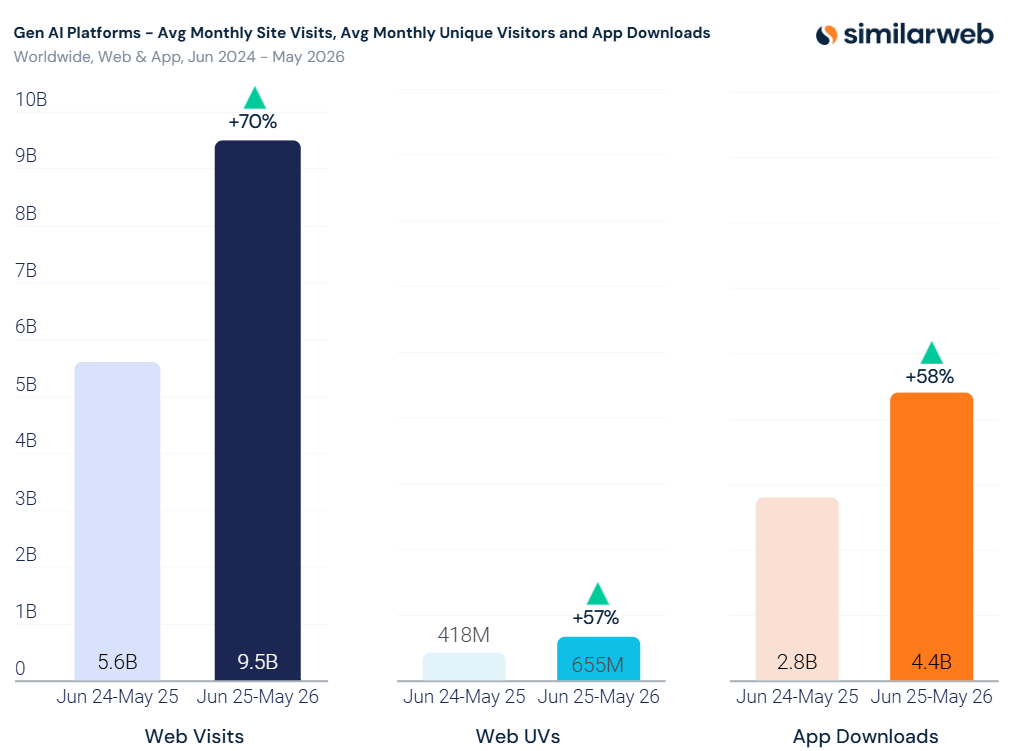
Between June 2025 and May 2026, generative AI platforms recorded an average of 9.5 billion monthly visits, a 70% year-over-year increase. Unique visitors reached roughly 655 million, up 57%, while app downloads grew 58% to reach 4.4 billion.
 Source: Similarweb, The 2026 Generative AI Landscape Report
The gap between visit growth and unique-visitor growth is particularly telling. Growth is no longer coming only from new users discovering these services: people already won over to AI are using it more and more often.
Artificial intelligence is therefore no longer just an adoption phenomenon. It is becoming a daily digital habit, on par with Google search, social media, or messaging apps.
ChatGPT stays the leader, but its near-monopoly is gone
The most dramatic change concerns the redistribution of market share.
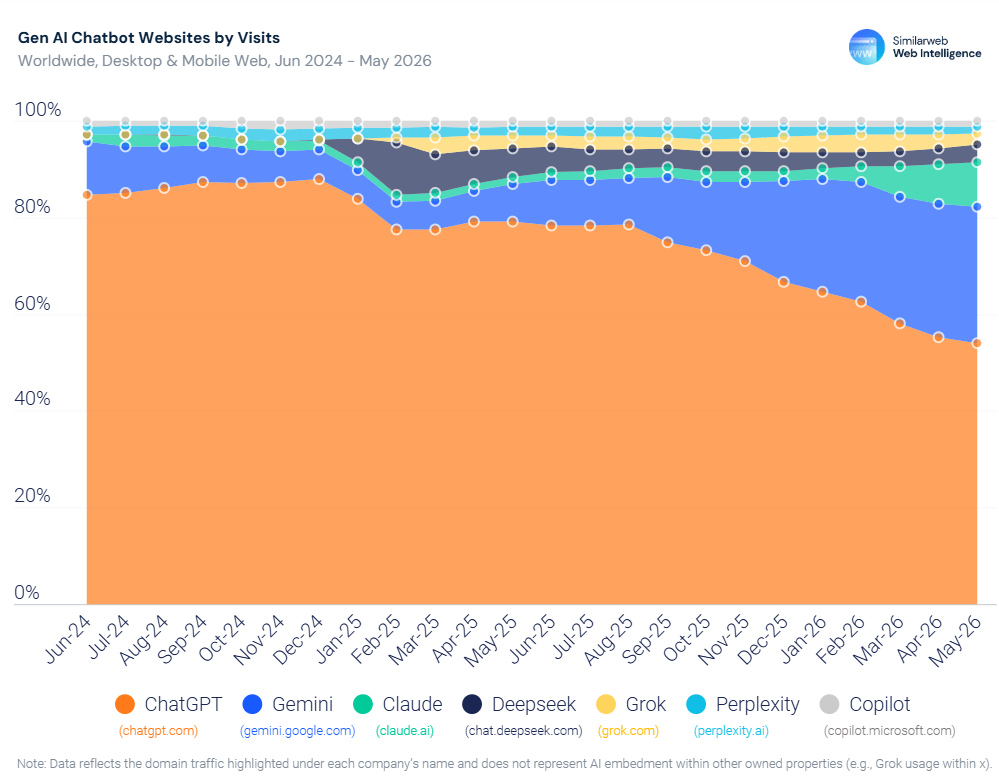
According to Similarweb, ChatGPT accounted for roughly 76% of worldwide visits to generative AI platforms in June 2025. By May 2026, its share had dropped to around 53%.
Over the same period, Gemini went from under 9% to roughly 27-28%, Claude went from about 2% to nearly 9%, and several players such as Perplexity, Grok, Copilot or DeepSeek continue to hold smaller but meaningful positions.
 Source: Similarweb, The 2026 Generative AI Landscape Report
That doesn't mean ChatGPT is collapsing, though. Its absolute visit volume remains substantial and relatively stable. Its share is falling mainly because the total market is growing and users are adopting several assistants at once.
In other words, the generative AI market isn't necessarily replacing one leader with another: it is becoming multi-platform.
This shift has an immediate consequence for brands. A visibility strategy focused solely on ChatGPT now covers just over half of generative AI tools' Web traffic.
Gemini and Claude aren't winning for the same reasons
Gemini and Claude are the two main beneficiaries of this fragmentation, but their trajectories are very different.
Gemini benefits from Google's distribution power. The assistant is being progressively integrated into Google Search, Android, Gmail, Google Workspace, Chrome, and Google-powered smartphones. This distribution sharply reduces the effort needed to adopt it: users don't always need to seek out Gemini or install a new service — the assistant comes to them within their everyday environment.
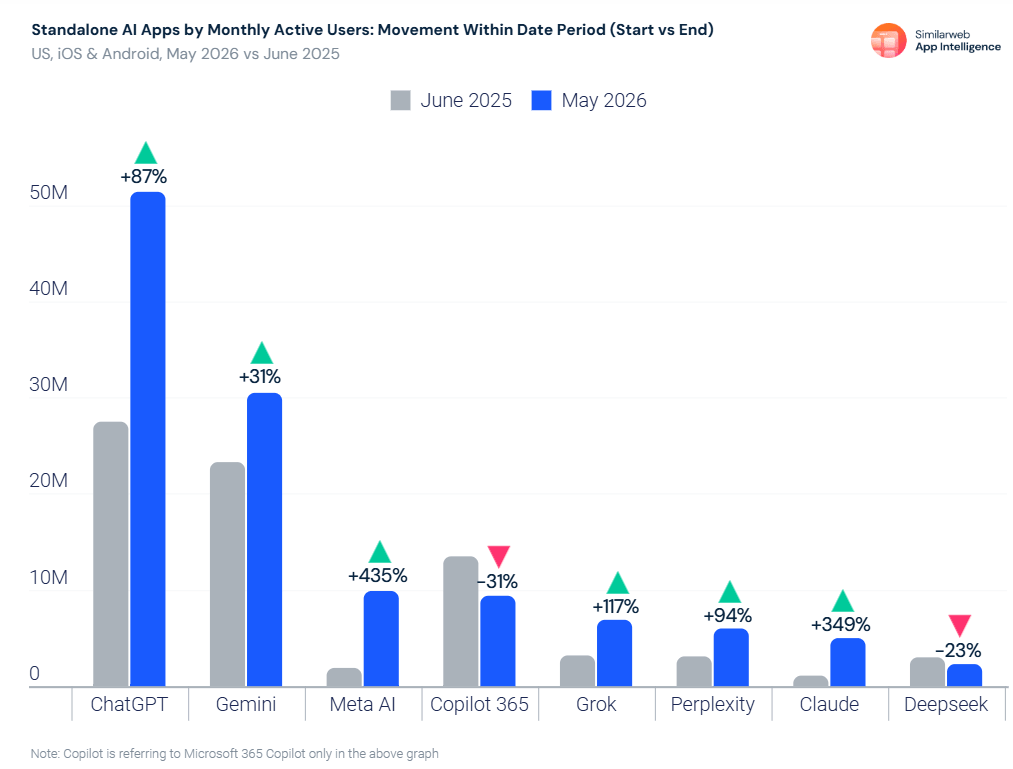
Claude is growing through deliberate adoption. Its growth comes more from users actively choosing the platform, notably among developers, knowledge workers, teams handling long documents, and experienced LLM users. Similarweb notes that Claude's unique visitors grew by roughly 180% in the second half compared to the first half.
On US mobile apps, Meta AI, Claude, Perplexity and Grok also show strong growth. ChatGPT nonetheless retains a far larger audience, with nearly 50 million monthly active users over the period studied.
 Source: Similarweb, The 2026 Generative AI Landscape Report
For a brand, this means distinguishing between two goals: maximizing coverage, which requires watching ChatGPT and Gemini, and reaching a professional or technically advanced audience, where Claude increasingly matters.
Traditional search and AI aren't mutually exclusive
The rise of generative AI doesn't mean people are abandoning Google.
According to Similarweb, about 95% of ChatGPT users also use Google. AI is therefore less an immediate replacement for the search engine than a new layer in the discovery journey.
A user might now discover a topic on Google, ask ChatGPT for a summary or comparison, search for a brand mentioned in the answer, visit its site directly, then come back to an AI tool to compare offers or prepare a decision.
This circulation between search engines, conversational assistants and brand websites makes attribution far more complex. Some of the value created by AI doesn't necessarily translate into an immediately identifiable click.
Brand mentions can drive visits without a classic citation
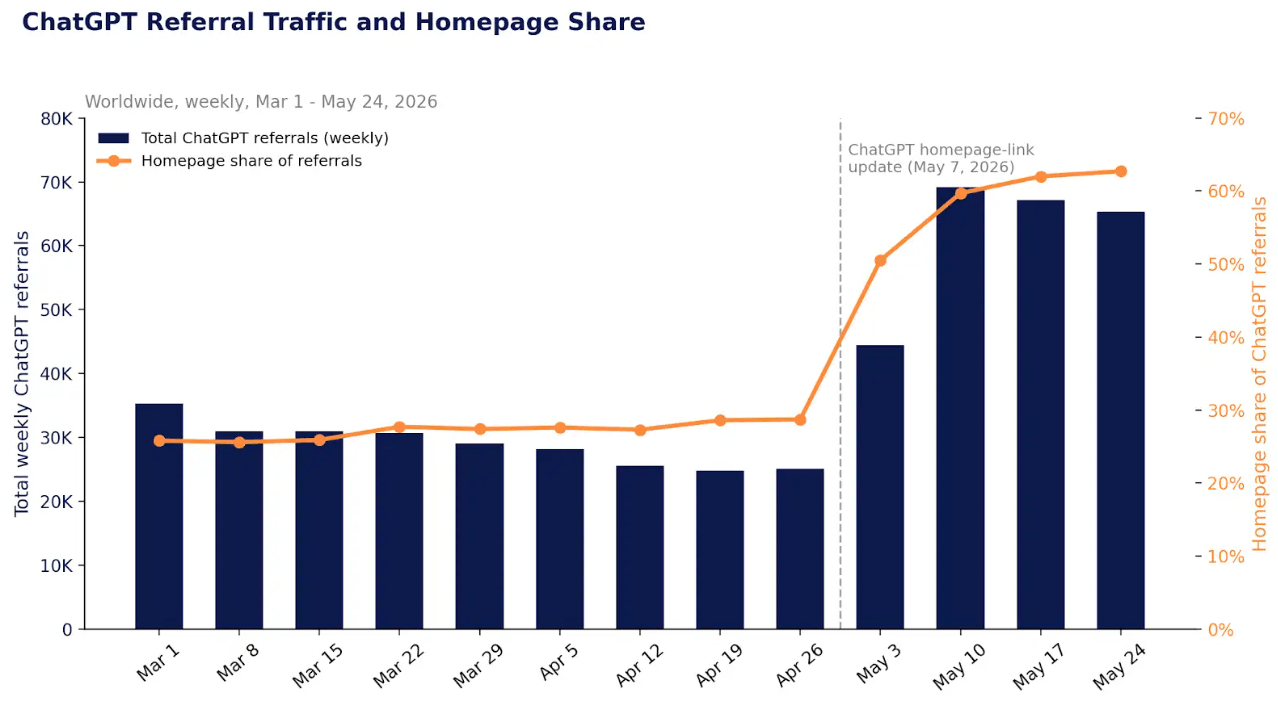
In May 2026, ChatGPT changed how some brand links were presented. Instead of confining links to footnotes or secondary references, the platform started making certain brand names directly clickable within its answers.
According to Similarweb, the share of visits directed to brand homepages went from roughly 26-29% before this change to over 60% after it rolled out.
 Source: Similarweb, The 2026 Generative AI Landscape Report
This shift changes the nature of traffic coming from AI assistants. In traditional search, a user typically clicks through to a specific page matching their query. After an AI-generated recommendation, they may instead land directly on the homepage because they've already received a company overview, a comparison with competitors, an initial assessment of the offer, and arguments in favor of the brand.
The homepage is no longer the starting point of the search. It becomes the last step of a pre-selection process that happened inside the assistant.
Companies should therefore pay closer attention to spikes in direct traffic, visits to their homepage, branded searches, and conversions preceded by exposure in an AI answer. Some of what's labeled "direct" traffic may now stem from a generative recommendation that's hard to attribute.
Source citations are growing, but remain rare
Citations are one of the central topics in Generative Engine Optimization, or GEO.
Similarweb estimates that the share of ChatGPT queries containing a citation rose from roughly 1.6% in June 2025 to 6.8% in May 2026 in the US on desktop. The rate has thus more than quadrupled in under a year, even though it remains low in absolute terms.
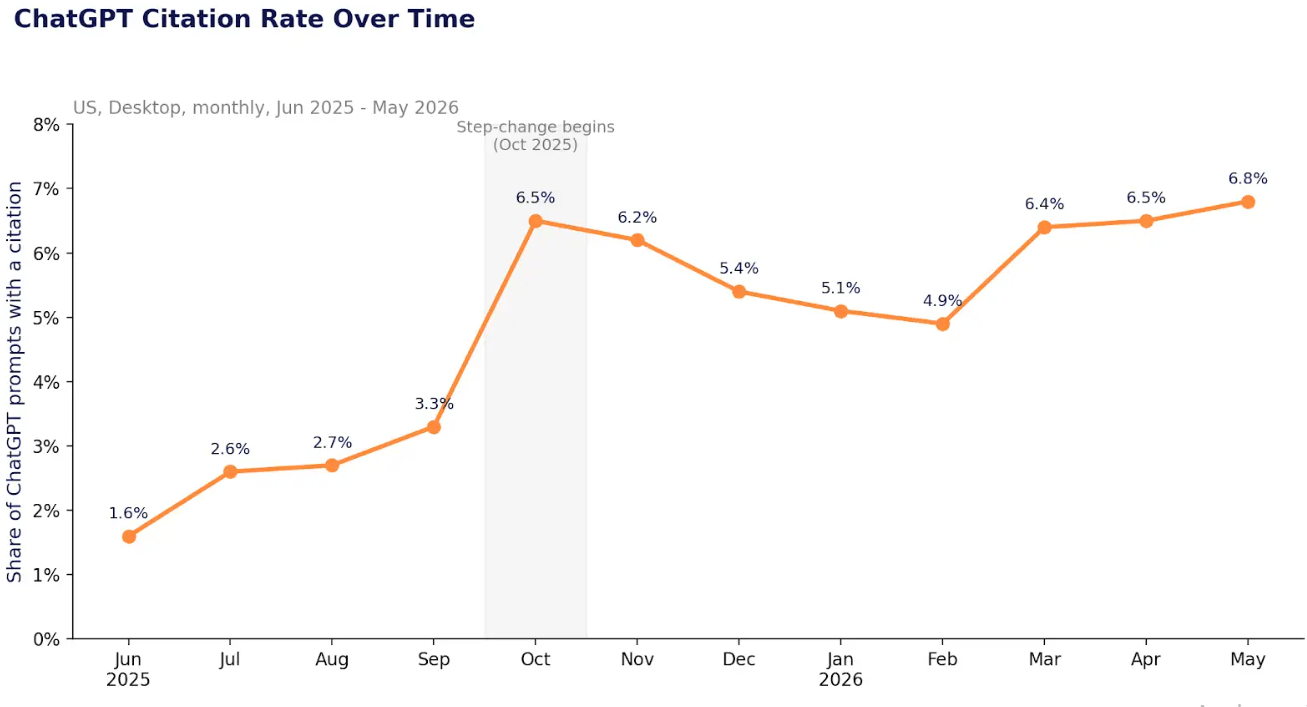 Source: Similarweb, The 2026 Generative AI Landscape Report
This growth confirms that AI assistants increasingly rely on real-time search and retrieval mechanisms. It doesn't mean, however, that every answer will soon carry a long list of sources: platforms can draw on information from the Web without always displaying a visible citation.
That's why an AI visibility strategy shouldn't measure links alone. It should also track brand mentions, how products are described, presence in comparisons, attributes associated with the brand's name, the accuracy of information reused, and positioning against competitors.
In generative AI, being mentioned can sometimes matter more than being clicked.
Not all industries are equally likely to be cited
Citation rates vary widely depending on the nature of the query.
In May 2026, Similarweb observed the following rates: travel and hospitality around 22.6%, automotive around 19.5%, holding companies 14%, retail and consumer goods 13.5%, agriculture 11.6%, technology 6.6%, healthcare 6.3%, and professional services only 3.9%.
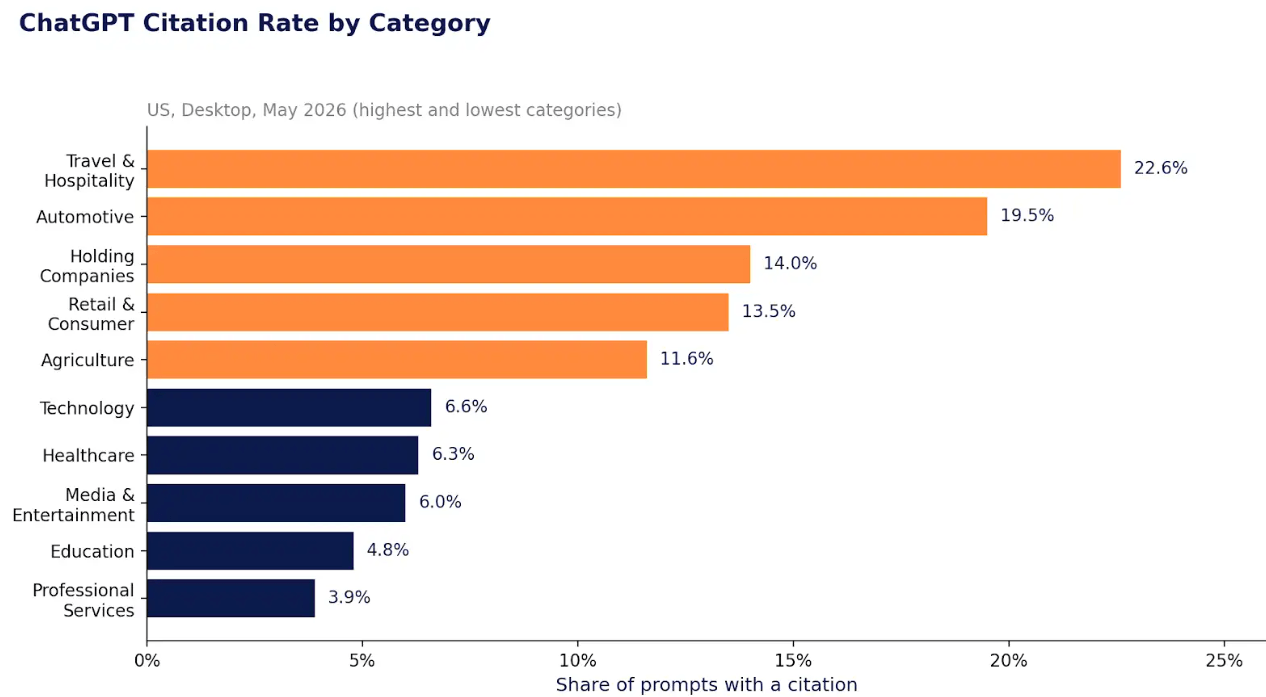 Source: Similarweb, The 2026 Generative AI Landscape Report
Sectors built on precise, verifiable, comparable information get cited more. Prices, vehicle specs, schedules, hotel availability or product data often require up-to-date sources.
Conversely, professional services tend to generate more general answers, where the model can rely on its internal knowledge without systematically citing a company.
For consulting firms, agencies and B2B providers, this lower frequency doesn't mean giving up. It shows instead that there's still real room to produce content AI systems will want to pull from: original data, industry studies, proprietary statistics, clearly described methodologies, detailed case studies, comparison tables, precise definitions, and factual, structured answers.
The arrival of advertising adds a third layer of visibility
AI assistant visibility has so far relied on two main mechanisms: being mentioned in an answer, or being cited as a source.
A third mechanism is now emerging: advertising embedded in generative answers.
According to the Similarweb report, roughly 26% of the ChatGPT responses studied included an ad. Among observed ad impressions, 33.7% appeared as early as the session's first response. That share then declined, but around 20.7% of impressions still occurred after the tenth interaction.
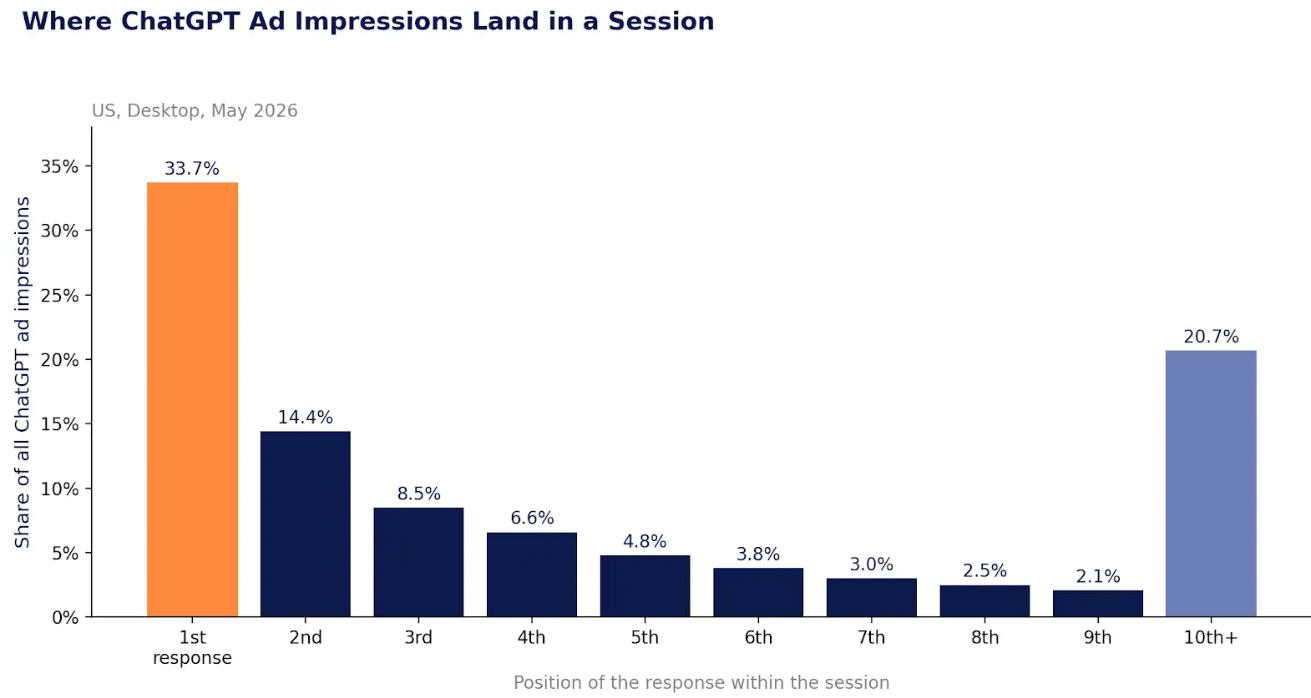 Source: Similarweb, The 2026 Generative AI Landscape Report
This distribution matters. The first response generally corresponds to a still-broad intent. As the conversation goes on, the user refines their needs, constraints, budget and decision criteria. An ad shown later may therefore reach fewer people, but a potentially much better-qualified audience.
AI visibility could thus come to be structured around three complementary layers: organic brand visibility, earned through mentions; editorial visibility, earned through citations; and paid visibility, earned through ad placements.
This shift echoes what happened with search engines, but with one major difference: the conversational context theoretically allows targeting based on the whole dialogue, not just a single query.
Google AI Overviews is spreading faster than AI Mode
Google is currently running two parallel transformations.
The first automatically integrates generative answers into traditional results through AI Overviews. The second relies on AI Mode, a more conversational interface the user has to actively choose.
Similarweb's data suggests passive integration is spreading faster than the voluntary interface switch. Over 40% of US searches triggered an AI Overview during the period studied, while growth in visits to AI Mode had stabilized after an initial acceleration phase.
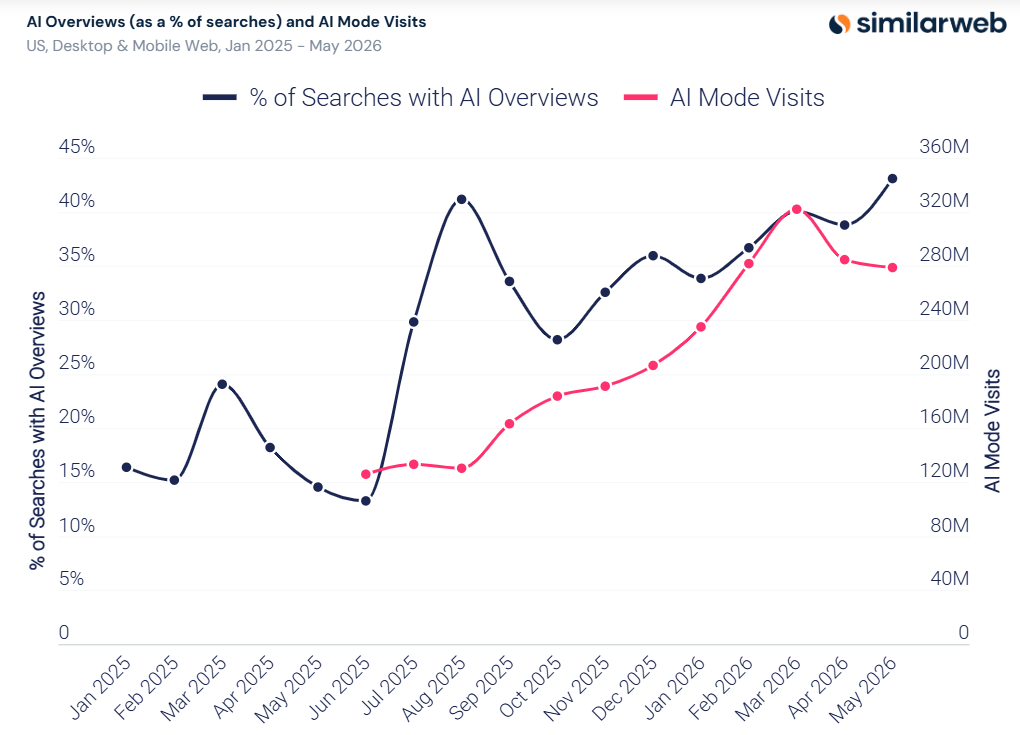 Source: Similarweb, The 2026 Generative AI Landscape Report
This result illustrates an important rule of technology adoption: users accept a new feature more readily when it shows up inside a tool they already use. The same logic partly explains Gemini's growth through Google, Meta AI's potential within WhatsApp, Instagram and Facebook, and Copilot's integration into Microsoft products.
The future of AI won't be decided solely by which models are best. It will also depend on which companies manage to embed those models into the digital environments already used by billions of people.
Queries are getting longer and more natural
Similarweb also notes a roughly 5.4% increase in the length of Google searches since AI Mode was introduced.
Users are gradually learning to phrase requests closer to natural language — for example: "What B2B prospecting software would suit a French industrial SME looking to export to Germany with a small sales team?"
That single query replaces several short searches that would previously have been run separately: B2B prospecting software, Germany export tool, SME sales automation, industrial lead generation.
For companies, this challenges an SEO approach built exclusively around isolated keywords. Content now needs to answer situations, constraints, comparisons, complex intents, and multi-step requests.
Good content no longer just targets a phrase. It has to provide enough context to be understood, synthesized, and recommended by a machine.
AI adoption is no longer limited to young users
Another common assumption is challenged by Similarweb's data.
The share of 18-24-year-olds among AI chatbot users has reportedly fallen by roughly six points since 2024, even as overall audience keeps growing. That doesn't mean young people use AI less in absolute terms — it mainly shows that adoption is now accelerating faster among other generations: executives, managers, independent professionals, buyers, older consumers, and less tech-savvy professions.
For brands, generative AI should no longer be treated as an experimental channel aimed at a young, technical niche. It is becoming a mainstream discovery channel.
What companies should do right now
Similarweb's data points to several operational priorities.
1. Stop optimizing for ChatGPT alone. A serious strategy should at minimum monitor ChatGPT, Gemini, Claude, Perplexity, Google AI Overviews, and any platform that matters in the target sector or region. Answers can vary considerably from one assistant to another depending on their sources, index, partnerships and retrieval mechanisms.
2. Strengthen SEO rather than abandon it. GEO doesn't replace organic search. Assistants that rely on real-time retrieval depend heavily on content that is accessible, indexable, and well-ranked in search engines. A drop in organic visibility can therefore also reduce the odds of being picked up by an AI. SEO is still the foundation; GEO adds a new layer on top.
3. Produce content that's easy to cite. The content AI systems can use most easily generally has an explicit title, a direct answer at the start of each section, dated data, identifiable sources, tables, comparison lists, clearly named entities, regularly updated pages, and consistent semantic markup.
4. Invest in original data. A company that publishes its own statistics becomes the primary source of that information. Surveys, benchmarks, barometers, market studies, product tests or industry databases are a real advantage. Content that simply rephrases existing sources is far easier to replace.
5. Measure mentions, not just clicks. Dashboards should increasingly track brand presence in AI answers, share of voice against competitors, products or services recommended, pages cited, sentiment and attributes associated with the brand, the frequency of errors or outdated information, and branded searches that follow AI exposure.
6. Treat the homepage as a conversion page. If a growing share of traffic sent by assistants lands directly on the homepage, it needs to immediately answer four questions: who are you, what do you offer, who is it for, and why choose you. It should clearly present proof points, references, case studies, geographic coverage, and calls to action.
From SEO to GEO: visibility becomes an ecosystem
The main takeaway from the Similarweb study isn't simply that ChatGPT is losing market share.
The fundamental shift is that online discovery is now spread across several environments: traditional search engines, AI Overviews, conversational assistants, mobile apps, AI-powered social platforms, sponsored answers, and brand recommendations with no immediate click.
In this ecosystem, success can no longer be measured solely by a Google ranking or organic traffic volume. A company can influence a decision without getting an immediate visit. It can be mentioned in an answer, remembered by the user, searched for later, and contacted directly.
Visibility is becoming less linear, but no less measurable. It simply requires new metrics and a more cross-cutting approach — which is exactly the approach we deploy through our SEO & GEO offer.
Conclusion: the era of multi-AI visibility has begun
ChatGPT remains the most-used generative AI platform, but it's no longer possible to build a strategy around a single assistant.
Gemini benefits from unmatched distribution. Claude attracts an engaged, professional audience. Google is directly transforming its results pages. Citations are growing. Traffic is shifting toward homepages. Ads are starting to appear inside conversations.
Companies waiting for the market to settle risk discovering too late that the new dominant positions have already been claimed.
The goal is no longer just to appear in Google. Brands need to become something AI systems can understand, identify, verify, cite, compare and recommend.
That is exactly the shift from traditional search engine optimization to a comprehensive strategy of SEO, GEO, and agentic visibility.
This article draws on data published by Similarweb in its report “The 2026 Generative AI Landscape” and its analysis “AI Search Stats 2026: Market Share, Referral, and Citation Data”. Figures should be interpreted according to Similarweb's methodology and measurement scope. The charts above are produced by Busony from this data, under license from Similarweb.