Conversational search, A2A and MCP protocols, automated bookings: how the Knowledge Catalog helps businesses be understood, found and engaged by AI agents.
Knowledge Catalog, conversational search, A2A and MCP protocols, automated bookings: a deep transformation of online visibility and commerce is underway.
For more than twenty years, companies' digital strategy has rested on a relatively simple principle: attract visitors to a website, then convert them into leads or customers. SEO, advertising campaigns, landing pages and forms were all designed around this journey.
But conversational search engines and AI agents are starting to shift this logic. A user can explain a problem to an AI, ask it to compare providers, verify information or recommend a solution. Some experiences now let the conversation extend into an action: checking availability, preparing a quote or booking a service.
The question is therefore no longer only: "How do I attract more visitors to my website?" It becomes: "How do I make sure AI systems understand my business, trust it and can interact with it?"
1. From traditional SEO to conversational search
The traditional model: attract, convince, convert
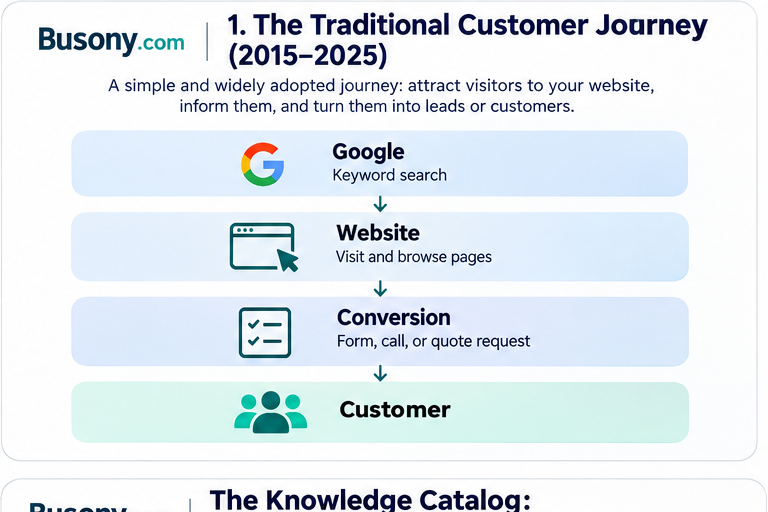
Until now, a large part of digital journeys followed a well-established sequence: Google search, website visit, contact, then conversion. A person would search "boiler repair Marseille," browse several results, compare companies and fill out a form or call.
This logic shaped SEO, Google Ads campaigns, landing pages, editorial content, chatbots, calls to action and conversion-rate optimization. It remains relevant: classic websites and search engines are not disappearing.
Conversational search changes the starting point
The need can now be phrased differently: "My boiler is making an unusual noise, it still works, but I'm worried it might break down. What could be the causes, and how much would a repair cost?" The AI can present hypotheses, suggest careful checks, explain the limits of its diagnosis and look up information about services.
The customer might continue: "Find me a qualified heating technician who covers my neighborhood and has transparent pricing." The AI then has richer context than a keyword search. It can compare companies by their services, location, reputation and the information they publish.
The company must therefore be identifiable, understandable and credible to a system that carries out part of the search on the user's behalf.
2. Three priorities to be understood and recommended
Publishing usable pricing information
People ask AIs about the price of a repair, a roof, a solar installation, an energy audit or a maintenance contract. A company that publishes no pricing indication leaves fewer verifiable elements for search systems. There's no need to disclose margins or every contractual rate: indicative ranges, included services, factors that affect price, options, and cases requiring a custom quote are already useful.
A solar company could publish "How much does a solar installation cost in 2027?" and explain system sizes, equipment, roof constraints, batteries and maintenance. This information should be dated, contextualized and kept up to date. It helps AI understand the offer, without guaranteeing a recommendation.
Enabling booking and transactions where relevant
"Find me a company to service my air conditioning this week and book an appointment." An agent with the right permissions and integrations could identify providers, check their service areas, query a schedule, propose a time slot and confirm a booking.
Preparation involves properly connected business software, reliable data, and interfaces able to expose availability and operations. A contact form remains useful, but it's no longer necessarily the only entry point. This shift affects home services, professional practices, hotels, travel and B2B activities.
Turning real customer questions into editorial assets
Generic articles are easy to produce and often interchangeable. Real conversations with customers, by contrast, reveal specific problems. "My heat pump has been using a lot more energy for the past two weeks: is that normal?" can become an FAQ entry, an expert article, a diagnostic guide, a video and a validated answer in the knowledge base.
The same approach applies to sales inquiries, support tickets, questions received by phone and technician feedback. It requires removing personal data, obtaining the necessary permissions, and having sensitive content reviewed by an expert. The company's documented experience becomes a source of differentiation.
3. From assisted search to personal agents
A conversational assistant answers a question; an agent able to use tools can also carry out steps of work. For example: "I need to get my car serviced before Friday. Find reliable garages, compare prices and suggest an appointment."
The customer could then get a selection and a proposal without browsing ten websites. The website remains important to build trust, provide evidence and enable human transactions, but it potentially stops being the only commercial interface.
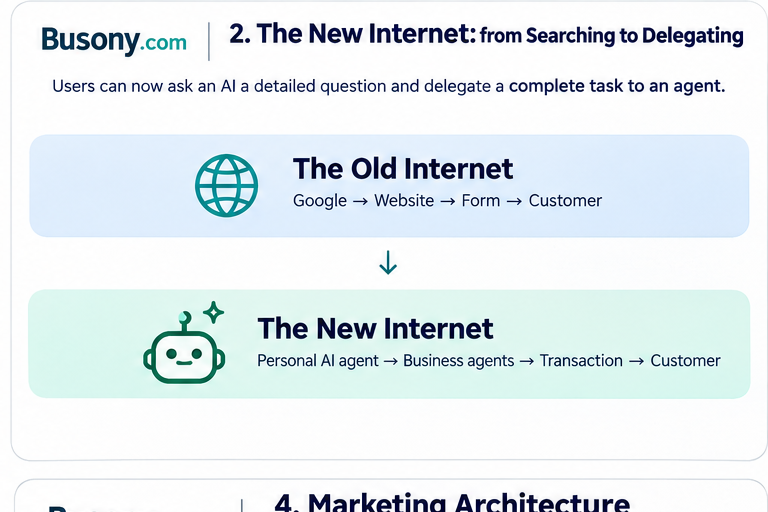
This is a gradual evolution, not an announced disappearance of websites. The capabilities available depend on platforms, countries, connected software, permissions and the user's own choice.
4. A2A and MCP: making agents interoperable
A2A: agents that collaborate
The Agent2Agent (A2A) protocol proposes a framework for exchanges between AI agents. If a customer asks "Where is my order?", their personal agent could contact the merchant's agent, which would then query authorized systems or partners to get a delivery status. A similar scenario can be imagined in travel: coordinating accommodation, a transfer and an activity.
A2A does not automatically grant access to every service. Agents must actually be available, and permissions, identities and security rules must be clearly established.
MCP: an agent connected to its tools
The Model Context Protocol (MCP) aims to standardize certain connections between AI applications, tools and data sources. Depending on its architecture, a company's agent can query a CRM, search documentation, check a catalog, verify availability or prepare an operation via an API.
MCP lets an agent use tools and resources; A2A lets several agents collaborate. These two approaches can complement each other, without removing the need for access control, confirmation and human validation.
5. The Knowledge Catalog: the informational foundation of the business
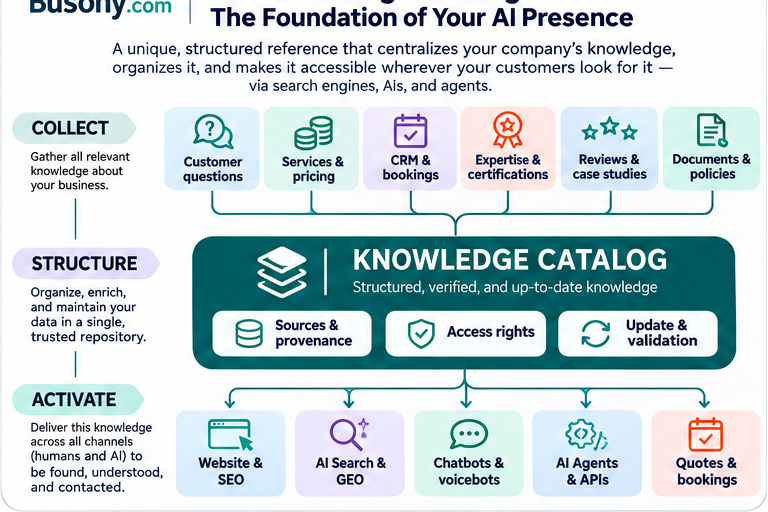
This is the central concept of this transformation. In most organizations, knowledge is scattered across web pages, PDF files, catalogs, ERPs, CRMs, procedures, emails and employee experience. One piece of data can be correct on the website and outdated in a brochure; another can exist in the CRM without being accessible to support.
In our approach, the Knowledge Catalog refers to an organized repository that gathers or references a company's useful knowledge, along with its provenance, validation status and usage rules. It is a general architectural concept, distinct from the similarly named commercial product offered by Google Cloud.
It can cover the company's identity, its products and services, its pricing, its geographic coverage, its certifications, its customer questions, its procedures, its guarantees, its reviews, its case studies, its available slots and its documents.
From stored documents to structured knowledge
A simple PDF brochure on air-conditioning maintenance isn't always enough for an agent to make a reliable decision. It helps to isolate elements such as the service, the covered area, indicative prices, restrictions, certifications, the source and the validation date. Dynamic data (stock, schedules, contractual prices) should be queried at the source rather than copied into a static database.
Such a catalog can combine structured data, document search and RAG, CRM/ERP connectors, business APIs, access controls and update rules. It is not a giant copy of every company database: it is a governed knowledge layer.
Trust is a property of data
For any important piece of information, you need to know who produced it, whether it has been validated, when it was last updated, who can access it, and whether it can trigger an action. This setup limits the risk of outdated prices, contradictory answers or the disclosure of private information.
6. From the Knowledge Catalog to different channels
Once knowledge is organized, it can feed several channels without multiplying contradictory versions: website pages and FAQs, SEO content, answers to generative engines, chatbots and voicebots, sales support and agents connected to business systems.
Three levels should be distinguished: publication (what the company makes public), consultation (what authorized applications and agents can read) and action (what a tool can execute after a check). A Knowledge Catalog doesn't mechanically improve citations in ChatGPT or Gemini: page discoverability, reputation and external sources remain essential.
7. The website becomes AI-ready
An AI-ready website isn't simply a website with a chatbot bolted on. Its offers, content and user journeys are designed to be understandable both by visitors and by authorized automated systems. This requires a clear architecture, consistent business information, accessible pages, relevant structured data and, where needed, secure business interfaces.
The company keeps its website as a place for identity, trust, references and conversion. It simply adds other ways to be discovered and engaged. Preparing for AI agents doesn't mean every journey must be automated: some sectors require human validation, confidentiality obligations or professional restrictions.
8. SEO, GEO and Agentic Commerce: four complementary building blocks
The Knowledge Catalog is the foundation of knowledge. SEO makes content findable in classic search engines. GEO/AEO aims to improve the presence and quality of brand representation in AI-assisted answers. Agentic Commerce targets operational interactions: quotes, bookings, purchases or other authorized transactions.
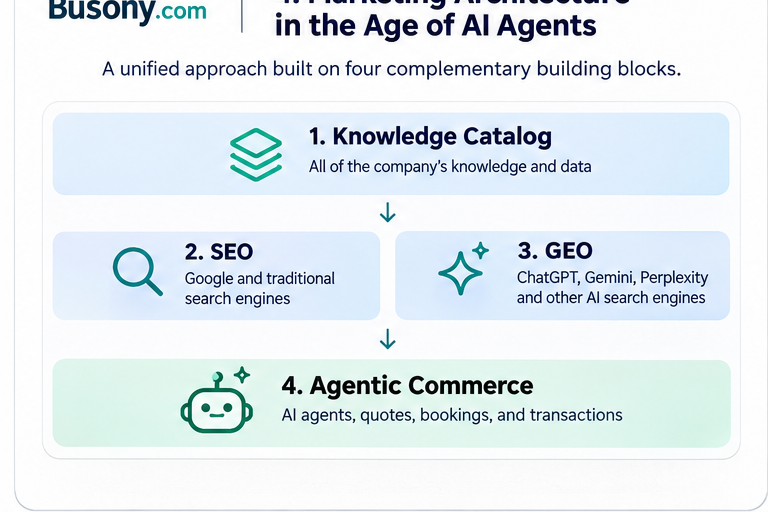
These dimensions aren't a mandatory technical pipeline. They interact, and their implementation varies by type of business. The point is to avoid treating visibility, data and conversion as three independent projects.
9. Building your Knowledge Catalog progressively
Step 1 — Inventory the sources. List the website, catalogs, CRM, ERP, documents, customer questions and procedures; identify confidential data.
Step 2 — Prioritize information. Start with services, prices, coverage areas, qualifications, FAQs, references and contact details.
Step 3 — Structure it. Define categories, business identifiers, relationships, sources and the fields needed for each type of information.
Step 4 — Govern it. Assign owners, organize validation and updates, set confidentiality and retention rules.
Step 5 — Connect it. Feed pages and agents with reliable information; query dynamic data at its source system.
Step 6 — Expose targeted actions. Gradually add availability, qualification, quoting or booking tools, with confirmation and rights control.
Step 7 — Measure and improve. Identify unanswered questions, errors and processes that are genuinely useful to customers.
10. Measuring visibility and business results
Clicks and sessions remain useful, but they don't describe every interaction with generative engines. Four families of metrics are worth distinguishing.
Mention rate: the proportion of tested answers in which the brand appears. Out of a defined sample of 100 queries, 35 answers citing the company correspond to 35%; this figure only makes sense with documented questions, platforms and parameters.
Share of voice: the brand's relative share of mentions among its competitive set, for a given test corpus.
Citation and recommendation rate: how often an official source is cited, and how often the company is explicitly proposed as the solution. A mention is not the same as a recommendation.
Business impact: qualified contacts, quote requests, bookings and attributable sales, within the limits of actually available data.
A sound approach is to repeat comparable tests rather than draw conclusions from a handful of isolated answers.
11. Actions to launch today
A company can prepare for this transition without immediately rebuilding its entire infrastructure. It can audit its website and reputation, test the questions customers ask AIs, publish detailed pricing content, build an FAQ based on real conversations, organize a first core of knowledge, connect a few business tools, and experiment with an agent within a controlled scope.
Governance, validation owners and measurement of results also need to be planned. Preparing for agents is, first and foremost, a matter of information and process quality.
12. The Busony vision: Be Found, Be Actionable, Take Action
Be Found — Being found, understood and considered. Improving visibility in traditional search engines and AI-assisted search: SEO, GEO/AEO, expert content, brand consistency and proof of credibility.
Be Actionable — Making the business accessible and usable. Designing AI-ready websites, organizing data, structuring journeys and preparing the interfaces that let authorized agents consult information or interact with services.
Take Action — Turning interactions into results. Deploying conversational agents, voicebots, chatbots and automations connected to business applications to qualify a request, prepare a proposal, schedule an appointment or escalate to a person.
The Knowledge Catalog connects these three pillars. It helps the company publish consistent information, present it to search systems, and put it to work for useful business interactions.
Conclusion: from page visibility to company knowledge
The current transformation doesn't mean websites will become useless. It suggests that a company's digital presence will no longer be limited to its pages. Its information, its reputation and the capabilities it makes accessible to agents will play a growing role.
The priority work is therefore not only to produce more optimized content. It also means organizing verified, traceable and maintained knowledge, designing accessible interfaces, and defining the actions an agent can safely perform.
Is your business only visible on the Internet, or is it also ready to be understood and engaged by artificial intelligence?
At Busony, this continuity between visibility, technical readiness and action is what guides our approach: Be Found. Be Actionable. Take Action.